RAISING DEATHSHEAD HAWK MOTHS: MY JOURNEY WITH ACHERONITA ATROPOS
There are some insects that immediately capture your imagination.
For me the Deaths Head Hawkmoth (Acherontia Atropos) is one of them.
With it’s enormous wings, bold yellow and black colouring and unmistakable skull-like marking, it is one of the most extraordinary moths around. It also has a reputation to match it’s appearance - from it’s association with folklore and superstition to it’s unusual habit of entering beehives to feed on honey.
So, naturally, I wanted to try raising them.
What followed was a rather steep learning curve involving eggs, caterpillars, pupae, adult moths, more eggs… and a lot of food.
This is the story of my journey raising Deaths Head Hawkmoths.
My First Attempt
In early 2024, I decided that Deaths Head Hawkmoths would be the first moth species I would try to raise.
I had done plenty of research and eventually placed an order for some eggs in March.
Then I waited.
And waited.
And waited some more.
The eggs didn’t actually arrive until August!
While I Was waiting, my impatience got the better of me, and I ended up raising Atlas Moths and Luna Moths instead.
Eventually. my Deaths Head eggs arrived.
Thankfully, I didn’t have to wait much longer after that.
They hatched, the tiny caterpillars began feeding and growing… and growing… growing, and before long they were ready to pupate.
It was incredibly exciting watching them progress through each stage.
Eventually, I had adult Deaths Head Hawkmoths emerging around November.
The First Generation
Getting to the adult stage felt like a huge achievement.
I’d successfully gone from tiny eggs to enormous caterpillars, through pupation and finally to those incredible adult moths.
But there was another challenge waiting.
I wanted the moths to reproduce.
The adults did well, but unfortunately none of the eggs they produced hathed
At the time, I suspected that the temperature in my home may have played a part.
I live in an old cottage, and winter temperatures can get surprisingly cold. I was still learning, and this first attempt taught me just how important environmental conditions can be when raising insects.
It wasn’t failure, though.
It was experience.
And I knew I wanted to try again.
A Second Chance.
Fast forward to 2025.
An amazing friend gifted me a large number of tiny Deaths Head caterpillars.
And suddenly, I had another opportunity.

They ate.
They grew.
They pupated.
They emerged.


Adult Deathshead Hawkmoths need to feed on a honey/water mixture, however will not feed alone and need to be hand fed!
Watching the whole process happen again was just as fascinating as the first time.
I was back at the point I had made it to successfully in 2024. The weather was on my side. It was warm. My moths got busy and egg laying started within a week or so, and boy can they lay! I’ve been getting new eggs every day for the last couple of weeks now.


Things are starting to slow down now, I only have 3 moths left and its only a handful of eggs each night now. The girls are old, and their wings are torn. I will miss them when they are gone!
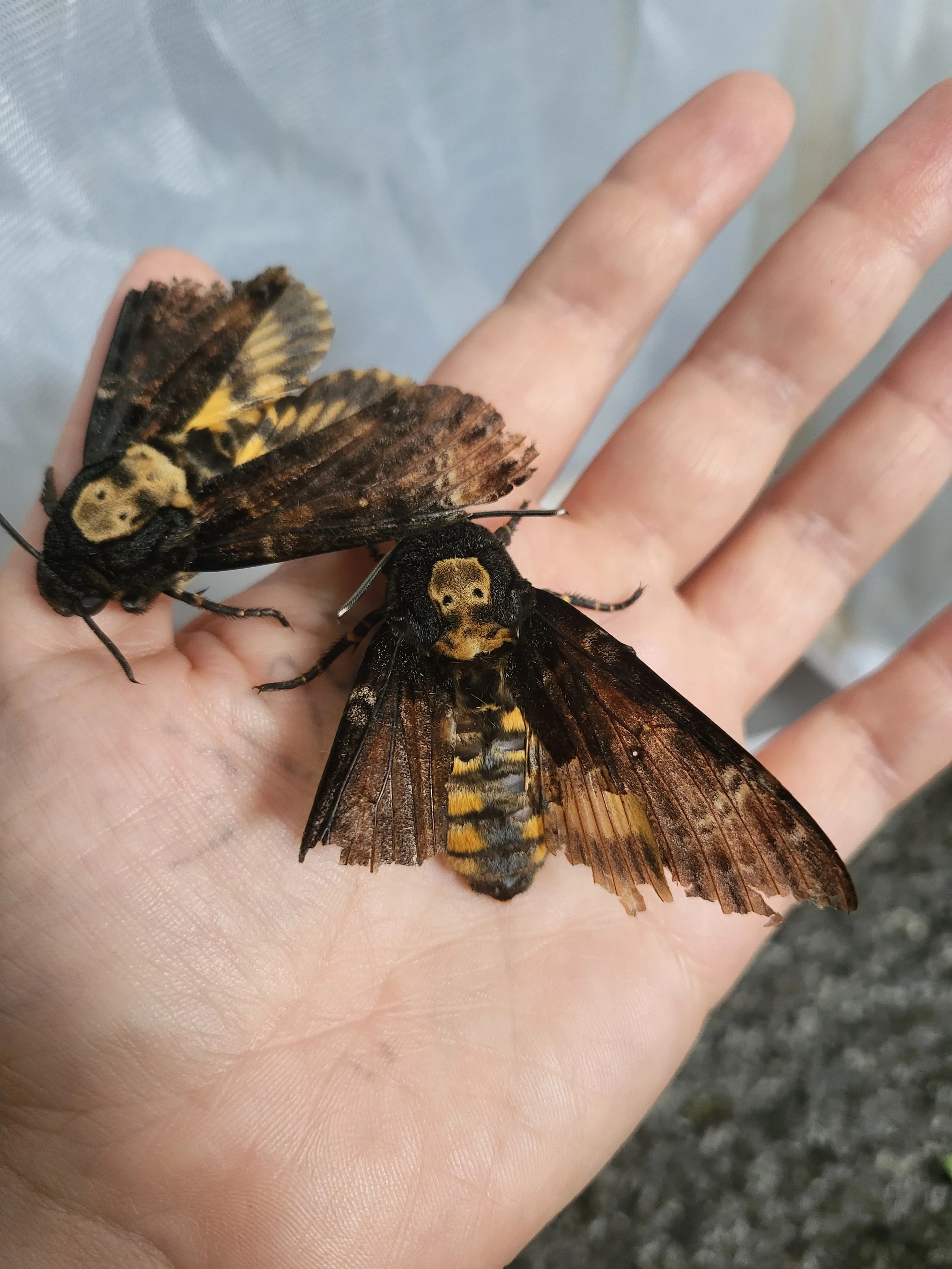
But I have over 1000 eggs which are all starting to hatch!


And so, the cycle starts again!
Deaths Heads are an amazing moth, they are an absolute pleasure to raise and care for.
A More In Depth Look At Raising
Raising The Caterpillars
One of the biggest things I have learned from raising these moths is that keeping caterpillars is much more work than it looks.
You might look at a tiny caterpillar and think:
“How difficult can it be?”
The answer is: surprisingly difficult.
Firstly, you need the correct food.
Caterpillars aren’t simply going to eat whatever plant happens to be sitting nearby. Different species have different host-plant requirements, so you need to make sure you can provide the right food, and enough of it, throughout their development.
And they eat.
A lot.
When you have a growing number of hungry caterpillars, you suddenly realise just how much plant material they can get through.
Having a reliable, safe, supply of suitable food is essential.
They Are Messy Little Creatures.
Caterpillars also produce an astonishing amount of frass - essentially insect poo.
I don’t think you truly appreciate just how much until you’re raising them yourself!
Their enclosure needs regular attention, with fresh food and cleaning to keep conditions suitable.
It’s a daily commitment - sometimes more than daily!
And when you have lot’s of caterpillars, that commitment becomes considerably larger and more time consuming.
Finding The Right Balance
One of the biggest challenges is getting the environment right.
Too warm.
Too cold.
Too humid.
Too dry.
All of these things can cause problems when you’re raising caterpillars
You also need to consider how much space they have.
Overcrowding can create problems, including increased risk of illness. But providing an enormous enclosure isn’t necessarily better either - very young caterpillars still need to be able to locate their food easily.
There’s a balance to find.
And sometimes, despite doing everything you can, things simply don’t go according to plan.
Caterpillars can die without an obvious explanation.
That’s one of the harder parts about keeping insects.
But it’s also part of learning.
Then Comes The Pupae
After weeks of feeding and growing, the caterpillars eventually reach the next stage of their journey.
Pupation.
This is one of my favourite parts of raising moths. The enormous, brightly coloured caterpillar disappears. For a while, everything becomes quiet. Then, eventually, the adult moth emerges.
The Arrival of The Adults
When my Deaths Heads emerged in 2025, I had finally reached the stage I had been working towards.
But Death Heads have an unusual requirement that makes keeping the adults rather different from keeping many other moth species.
The adults need to be fed.
This is no small task either. This involves hand feeding each moth a honey/water mixture.
Rather than simply putting the food into the enclosureand leaving the moths to feed, each moth must be hand fed to encourage them to feed.
This takes a little practise, and a little patience.
The first few times, they certainly weren’t impressed with me!
But with patience, I became more comfortable with the process, and the moths became easier to feed.
And when you’re caring for a large number of adults, it can become quite a time commitment.
And Then They Started Laying
It was around this time that the weather really started to warm up, and suddenly everything changed.
My moths became active, and within around a week egg laying was in full force.
And wow…
They can lay.
Eggs began appearing every day. In huge numbers.
The whole process had become a cycle:
Egg > Caterpillar > Pupa > Adult > Eggs
And the cycle starts all over again.
Saying Goodbye To the Adults
Eventually, things began to slow down. I am down to just 3 adult moths, and the number of eggs being produced each night has dropped to only a handful..
The females are getting old. Their wings are becoming worn and torn.
They have spent their adult lives flying, feeding and producing the next generation.
I know they are reaching the end of their journey.
And I will miss them.
There is something surprisingly emotional about keeping insects.
You watch them hatch from eggs, grow, emerge from their pupae, you care for them, you feed them, you watch them lay eggs, and eventually you have to say goodbye.
But The Cycle Continues
I had over 1000 eggs laid.
And they have already began to hatch. Tiny caterpillars are appearing everywhere.
And just like that, the cycle has started again.
In Summary
My Deaths Head Hawkmoth journey started with a handful of eggs and a lot of patience.
It led to caterpillars, pupae, adult moths, hundreds of eggs and an entirely new generation.
And I suspect this won’t be my last adventure with them.
What Raising Deaths Head Hawkmoths Has Taught Me
Raising moths has taught me that there is so much more to simply putting a caterpillar in a container and watching it grow.
There is planning. There is research. There is cleaning. There is sourcing food. There is monitoring conditions. There is patience. And sometimes, there is disappointment.
But there are also amazing moments that make all of it worth while:
Watching a tiny egg hatch
Watching a caterpillar moult
Finding freshly formed pupae
Watching an adult moth emerge
Seeing an adult moth laying eggs
Those moments are incredible.
Do Your Research First
If you’re thinking about raising Death Head Hawkmoths - or any other insect species - my biggest piece of advise is simple:
Do your research before bringing them into your home.
Make sure you understand the species requirements.
Make sure you can provide suitable food.
Make sure you have the space and time required.
And make sure you’re prepared for the fact that things don’t always go perfectly.
Every species is different, and what works for one insect, may not work for another.
I’ve made mistakes during my own journey, but that is how you learn.
Why I Love Raising Insects - Particularly Moths
There is something magical about watching metamorphosis happen in front of you .
An egg becomes a caterpillar. The caterpillar becomes a pupae. And from a wiggling pupae emerges something completely different. A moth!
It’s a reminder that the natural world is full of things that seem impossible until you witness them yourself.
And Deaths Head Hawkmoths are particularly special. They are enormous, unusual, slightly eerie and completely fascinating.
Exactly the sort of creature that belongs in a cabinet of curiosities.
____________________
Explore more stories from behind the cabinet, explore The Grimoire
